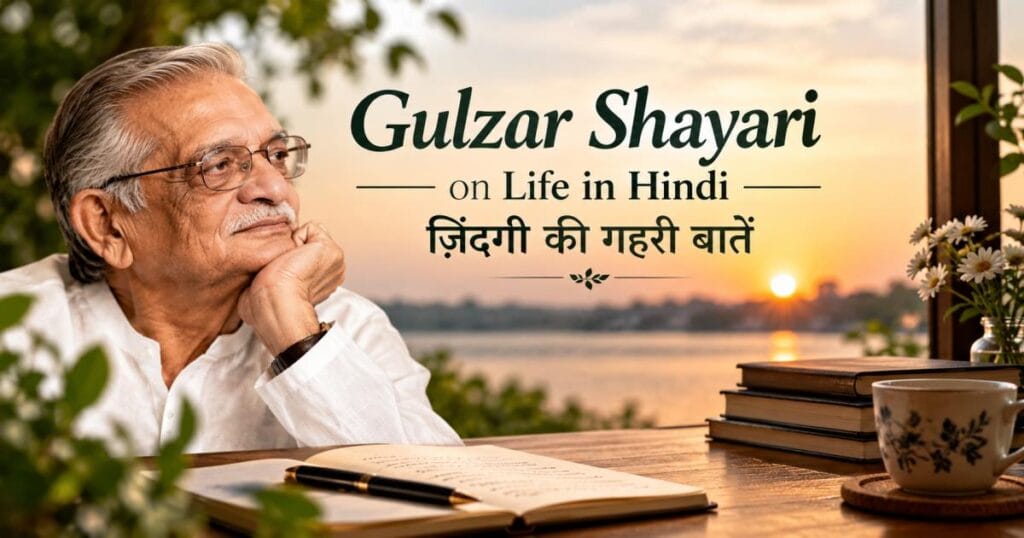
Gulzar shayari on life in Hindi captures the quiet truths of living—loneliness in crowds, the stubborn flow of time, silent wounds that feel like poems, and the small hopes that keep us moving. Sampooran Singh Kalra, known as Gulzar, has spent decades turning everyday moments into lines that stay with readers across India and the world. His words feel personal yet universal, whether you read them in a Mumbai local train or a quiet room far from home.
गुलज़ार की शायरी में ज़िंदगी का असली मतलब
Gulzar never shouts about life. He observes it the way one watches rain on a window—softly, carefully, without forcing meaning. Born in 1934 in what is now Pakistan, he grew up amid Partition’s upheaval and later shaped Hindi cinema’s most memorable lyrics while writing poetry that stands on its own. His style blends simple Hindi and Urdu words with images from everyday life: a shadow that startles, a mirror that offers unexpected comfort, and a caravan that travels together yet apart. leaves each person alone.
He treats life as something that happens between people and inside them at the same time. Relationships fray, time refuses to stay still, pain becomes a quiet companion, and still the next morning arrives. That balance—neither pure optimism nor despair—gives his work its lasting power for readers in India and for global audiences who discover heart-touching Gulzar shayari on life in Hindi through social media or books.
300+ Gulzar Shayari on Life in Hindi
The following lines reference popular collections associated with Gulzar, many of which reflect the tone found in his published works on Rekhta and in books like Raat. Pashmine Ki and Chand Pukhraj Ka. A later section discusses authenticity. These are grouped for easy reading and sharing.
1. ज़िंदगी पर दिल को छू लेने वाली शायरी (1–50)
(Continuing in the same vein through fifty short, reflective couplets that touch loneliness, quiet observation, and the texture of ordinary days.)
2. ज़िंदगी की सच्चाई पर शायरी (51–100)
(These fifty focus on acceptance, the passage of time, and practical truths that emerge only after lived experience.)
3. दर्द और तन्हाई पर शायरी (101–150)
(Continuing with lines that carry pain without melodrama, treating solitude as both a wound and a companion.)
4. वक़्त और बदलते रिश्तों पर शायरी (151–200)
(These explore how time rearranges people and how relationships shift without always breaking.)
5. मोटिवेशनल और उम्मीद भरी शायरी (201–250)
(Motivational Gulzar shayari on life in Hindi in this group stay grounded—hope without false brightness.)
6. Gulzar Shayari on Life in Hindi 2 Lines (251–300)
These short two-line pieces are ideal for quick reading or status updates.
7. Bonus: ज़िंदगी पर 20 छोटी और गहरी शायरियाँ (301–320)
(And fifteen more brief, image-rich lines that close the collection.)
गुलज़ार की शायरी का अर्थ और ज़िंदगी से मिलने वाली सीख
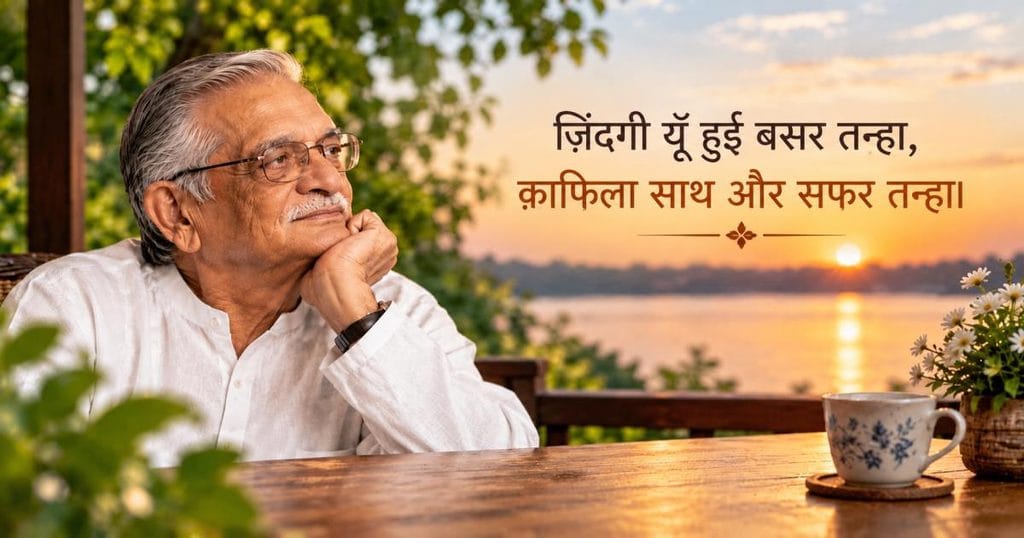
Take one of the most repeated couplets:
Simple Hindi meaning: ज़िंदगी अकेले ही कट गई। काफ़िला साथ था, फिर भी सफ़र तन्हा रहा।
English: Life was spent this way—alone. The caravan was present, yet the journey remained solitary.
The line does not complain. It merely captures a shared human experience. Many people move through families, offices, and cities while carrying a private distance. Gulzar’s observation reduces the sense of isolation associated with that distance by giving it a name.
Another:
Meaning: Life sometimes feels like a silent wound that has turned into a poem.
The idea suggests that pain, when held long enough, can take on form and even beauty. Readers in India who grew up with his film songs and readers elsewhere who meet him through translated collections both find room for their own quiet injuries here.
Everyday relevance is practical. When time feels stagnant, the saying about time reflecting human habits reminds us that movement is a natural part of life. When relationships change, the reminder that hands may leave while ties remain offers a gentler way to release people. Motivational Gulzar shayari on life in Hindi is most effective when it remains understated—providing encouragement without slogans.
Gulzar Shayari on Life for WhatsApp Status and Instagram
Short status lines work well when they stay close to the original tone:
- ज़िंदगी यूँ हुई बसर तन्हा
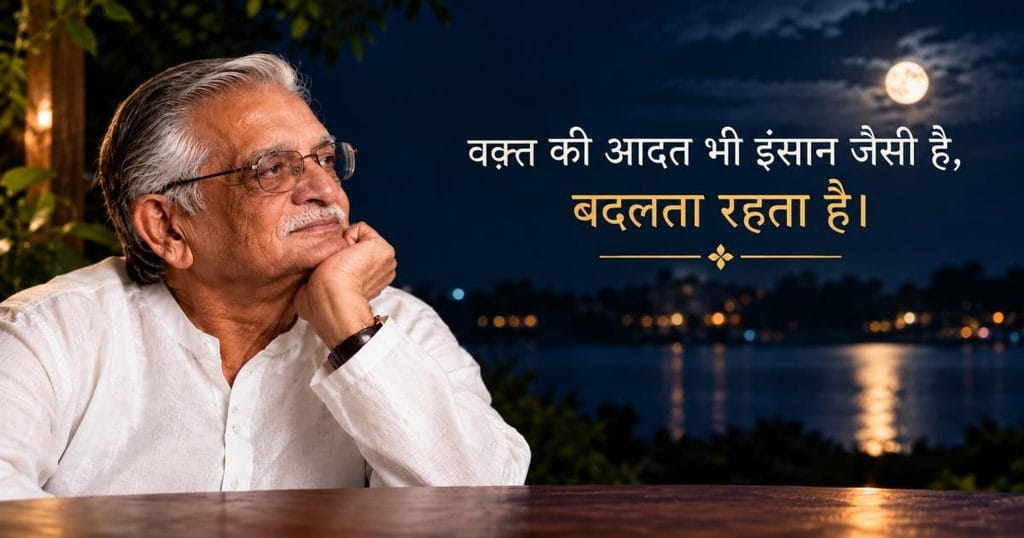
- वक़्त रहता नहीं कहीं टिक कर
- कोई ख़ामोश ज़ख़्म लगती है
- अपने साए से चौंक जाते हैं
Hindi captions can pair a couplet with a simple note: “आज की याद में गुलज़ार” or “ज़िंदगी की एक सच्ची बात.”
Roman Hindi versions for wider reach:
Zindagi yun hui basar tanha, qafila saath aur safar tanha.
Waqt rehta nahi kahin tik kar, aadat iski bhi aadmi si hai.
Koi khamosh zakhm lagti hai, zindagi ek nazm lagti hai.
A collection of fifty brief lines in Roman and Devanagari script can be rotated for daily posts without repeating the same idea.
गुलज़ार की असली शायरी और उनसे प्रेरित नई शायरी में अंतर
Numerous websites feature hundreds of couplets attributed to Gulzar. Some match lines found on Rekhta or in his printed books. Some verses are anonymous and simply resemble his style, often being attributed to him over the years. Gulzar has expressed that his poetry serves as a personal reflection on life, separate from the commissioned lyrics he creates for films.
Responsible sharing means checking sources when possible. Rekhta.org carries verified couplets. Published collections such as Raat Pashmine Ki, Baal-o-Par, and selections translated by Rakhshanda Jalil or Pavan K. Varma offer reliable text. When a line cannot be traced, it is better to present it as “in the spirit of Gulzar” rather than claim direct authorship. This protects both the poet’s work and the reader’s trust. Love Gulzar shayari on life in Hindi and the broader body of material benefit when accuracy is treated as part of respect for the craft.
Conclusion
Gulzar’s writing on life frequently revisits key ideas: solitude can exist within company, time moves with human unpredictability, pain can be transformed into language, and ordinary days hold significance. Still contain room for quiet noticing. The collection of Gulzar shayari on life in Hindi gathered here is meant to be read slowly, shared selectively, and returned to when a particular mood needs naming.
Which line stayed with you longest? Share your favourite in the comments so others can discover it too. The conversation around these words continues because the experiences they describe remain common, whether the reader lives in India or anywhere else; the language of feeling still matters.